
When Hospital Assets Leave Controlled Environments, Most Tracking Systems Stop Helping
Hospitals do not lose time only when equipment disappears. They lose time when equipment crosses floors, exits buildings, or leaves controlled coverage. Here is why hospital asset recovery depends on position continuity, not more tracking infrastructure.
Juxta
Juxta Team
Hospitals rarely lose equipment in dramatic ways. They lose it in quiet operational seams.
A pump gets rolled to another department and never properly handed back. A wheelchair leaves a discharge area and ends up in a parking structure, a lobby corner, or a transport staging zone. A monitor follows a patient movement path farther than expected and disappears from the staff’s usable picture. The operational problem is not always that the asset is gone. The problem is that the hospital no longer has a trustworthy location narrative for where it went next.
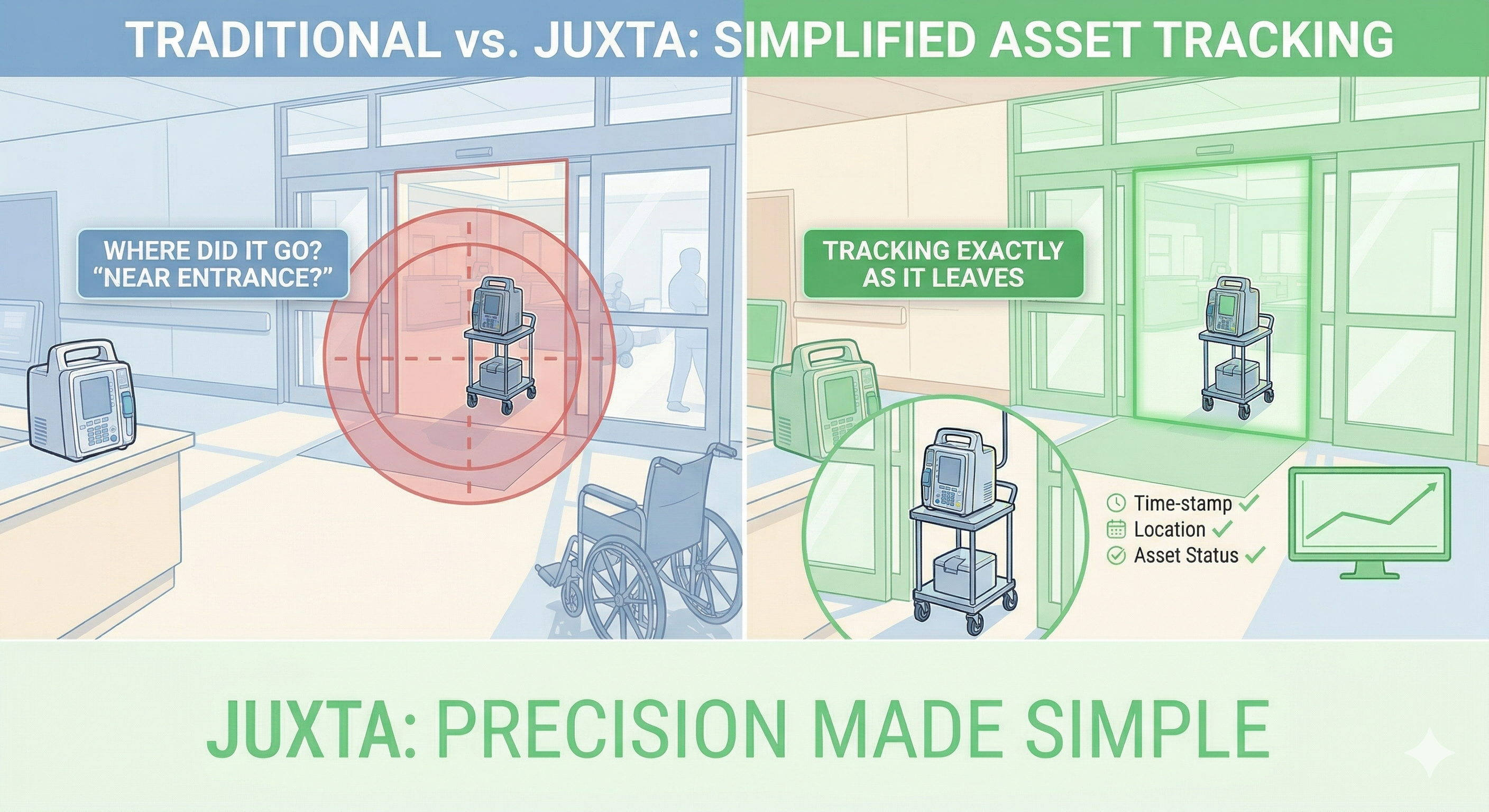
A wheelchair in a public entrance. A pump moved off-floor. A monitor that leaves the building for servicing, transfer, or the wrong handoff. Most hospital tracking systems perform best inside controlled zones and weaken at the exact moment recovery matters most. The real problem is not alerts. It is the position layer underneath them.
That is where most tracking stacks stop being useful.
The hospital asset problem does not start with theft
Hospital leaders often inherit the wrong framing. They are told the asset problem is about shrink, compliance, inventory count accuracy, or replacing manual search with better dashboards. Those are downstream effects. The upstream issue is simpler.
Hospitals need to know where mobile equipment is as it moves through real operating conditions.
That includes:
- Crossing from one floor to another without a clean handoff.
- Leaving a department boundary without a meaningful recovery signal.
- Moving through elevators, corridors, receiving areas, and public-facing zones.
- Passing from controlled interior space into ambiguous or mixed environments.
- Reappearing later with no clear movement history anyone can trust.
When the location layer breaks, every workflow above it becomes slower. Search expands. Escalations multiply. Staff confidence drops. Asset utilization data becomes harder to trust. Recovery becomes reactive instead of operational.
Why controlled-environment tracking breaks at exits, handoffs, and off-floor movement
Many hospital tracking deployments are built to perform best inside known, instrumented, and relatively stable environments. That sounds reasonable until the asset does what hospital assets always do: move.
The moment equipment crosses an operational seam, systems begin to rely on weaker assumptions.
Maybe the asset is still inside a building, but no longer in a high-confidence zone. Maybe it moved through a corridor, elevator bank, or discharge path that was never designed to preserve clean continuity. Maybe it left the floor, left the department, or left the building entirely.
Maybe the system can tell you where it was last seen, but not where it actually went.
That is the hidden failure mode in hospital asset tracking. Coverage is often strongest where operations are most controlled and weakest where recovery becomes most important. Hospitals do not need a tracking stack that performs best during normal conditions. They need a positioning layer that remains useful when assets move through exceptions, ambiguity, and bad handoffs.
Asset recovery fails when the last known location is not operationally useful
“Last seen” is one of the most misleading phrases in hospital operations.
It sounds actionable. Often it is not.
If the last seen location is a floor from forty minutes ago, staff still have to search. If the system confirms only a coarse zone, recovery is still manual. If the asset crossed into a transition area before visibility degraded, the hospital is left with a breadcrumb, not an answer.
That is why asset recovery cannot be judged by whether a system generated an event. It has to be judged by whether the system preserved enough movement truth to shorten recovery time in the real world.
Operationally useful recovery means answering questions like:
- Did the asset stay in the building or move beyond it?
- Which transition path did it most likely follow?
- Was the movement ordinary, misrouted, or anomalous?
- Which team should act first based on confidence, not guesswork?
- Is this a retrieval task, a handoff problem, or a loss event?
Those are not dashboard questions. They are position continuity questions.
Why infrastructure-heavy tracking turns hospital recovery into a facilities program
This is where many hospitals get trapped. To improve recovery, they are often asked to expand hardware, add more readers, increase calibration effort, densify infrastructure, or treat visibility as an installation problem.
That usually creates a different burden instead of solving the original one.
A hospital does not just buy a location system. It inherits a facilities program. Someone owns rollout. Someone owns exceptions. Someone owns dead zones, upgrades, maintenance, expansion plans, and the politics of which buildings or departments get covered first.
The result is familiar. Coverage becomes uneven. Rollouts take longer than expected. The most mobile workflows remain the hardest to capture. The system becomes strongest where infrastructure is easiest to maintain, not where operations most need certainty.
That is the category mistake.
The hospital asset problem is not primarily a hardware density problem. It is a continuity problem. The goal is not to surround every exception with more infrastructure. The goal is to preserve useful movement truth as assets move through the hospital’s real operating environment.
What hospitals actually need: position continuity across buildings, floors, and exits
Hospitals need more than room-level visibility in ideal conditions.
They need continuity across:
- Departments that share assets but not ownership.
- Floors connected by elevators, stairs, and transport routes.
- Public-facing discharge and entrance areas with constant motion.
- Receiving, staging, and back-of-house zones where equipment is often parked or redirected.
- Building exits, service transfers, and ambiguous edge conditions where recovery gets harder.
That is a different requirement than traditional indoor visibility.
It means the positioning layer has to survive movement, not just snapshots. It has to support real recovery, not just logging. It has to maintain enough confidence across transitions that an operator can still act decisively after the asset leaves the environment where old assumptions were strongest.
This is exactly where Universal Positioning System thinking becomes more useful than legacy tracking categories.
How infrastructure-free positioning changes hospital asset recovery
Infrastructure-free positioning changes the hospital conversation because it attacks deployment friction and continuity failure at the same time.
Instead of treating hospital recovery as a site-install problem, it starts with a software-defined position layer built for movement across imperfect environments. Instead of assuming dense hardware coverage, it focuses on preserving usable location truth through the transitions that normally degrade confidence.
For hospitals, that changes several things at once.
First, deployment becomes easier to scale across buildings and floors without turning every expansion into a new infrastructure project.
Second, recovery gets closer to operational reality. The system is not limited to proving that an asset was somewhere. It is built to preserve a stronger narrative of how it moved.
Third, the hospital is less likely to split visibility into separate systems for “inside,” “edge zones,” and “everywhere else.” That fragmentation is one of the main reasons equipment recovery becomes slow and expensive.
Fourth, hospitals can begin to treat off-floor, cross-building, and exit-adjacent events as first-class workflows rather than exceptions outside the model.
That is where Juxta architecture matters.
Juxta starts by polygonizing real spaces from floor plans or site imagery, generating synthetic IMU movement data instead of requiring heavy manual setup, and training accuracy engines that support on-device inference with drift minimization and offline resilience. The result is a position layer designed to stay useful across the seams where conventional tracking often loses value.
For hospital operations, that matters more than another alert.
It means the system is built to support retrieval, routing, accountability, and continuity without requiring the hospital to keep expanding the infrastructure burden underneath it.
From search reduction to operational confidence
Hospitals usually begin the asset conversation with search time. That makes sense. Search is visible, painful, and expensive.
But the bigger opportunity is operational confidence.
When hospitals can trust the movement layer underneath mobile equipment, they make better decisions faster. Staff spend less time improvising recovery. Departments stop blaming one another for missing assets they cannot actually trace. Utilization becomes more believable. Escalations become more precise. Exceptions become manageable.
That is the shift.
Not from manual search to digital search.
From fragmented visibility to durable positioning.
The hospitals that win this category will not be the ones with the most dashboards or the most hardware. They will be the ones that can maintain position continuity when equipment moves across the messy, public, multi-floor, edge-condition reality of care delivery.
That is when asset recovery stops being a recurring fire drill and starts becoming a real operational capability.
Hospitals do not need more alerts about where equipment used to be. They need a position layer that stays useful when assets move through exits, handoffs, and off-floor transitions. See how Juxta brings infrastructure-free positioning to hospital operations: https://www.juxta.com/book-demo