
What Will Actually Define Transportation & Logistics in 2026: Continuous Positioning, Not Just Intelligent Operations
If your logistics visibility still breaks at the warehouse door, in the yard, or during offline handoffs, it may be time to rethink the positioning layer underneath your operations.
Juxta
Juxta Team
For years, the industry has been told that the next leap forward will come from smarter workflows, better dashboards, more automation, and more connected operations. That framing sounds reasonable because it points to real pressures: tighter margins, higher service expectations, more volatile networks, and less tolerance for operational blind spots.
But it also skips the harder question.
What happens when the underlying location layer breaks?
That is where the next divide in transportation and logistics will actually emerge. Not between teams with more dashboards and teams with fewer. Between operators that can maintain continuous positioning across real operating environments and those still relying on fragmented moments of visibility stitched together after the fact.
Transportation and logistics does not have a software shortage. It has a continuity shortage.
The real bottleneck is not orchestration
Most transportation and logistics organizations already understand the basic playbook. They know they need tighter planning, faster decisions, better labor coordination, stronger partner communication, and more resilient execution. They know visibility matters. They know automation matters. They know real-time data matters.
The problem is that orchestration only works when the underlying reality is dependable.
If a system knows where a trailer was at the gate but loses confidence once it enters a covered yard, the workflow layer is compensating for a location failure. If a delivery network can optimize routes but cannot preserve trustworthy movement truth through dense urban corridors, indoor loading areas, or offline zones, the intelligence layer is operating downstream of a broken primitive. If operations teams can see scans, pings, and checkpoint events but not continuous movement across the messy seams of actual logistics, that is not intelligent operations. It is partial observability.
And partial observability is expensive.
It drives dispatcher intervention. It inflates search time. It increases exception volume. It creates disputes around custody and timing. It weakens ETA confidence. It makes proof reactive instead of native. It forces people to bridge uncertainty with calls, guesswork, and manual escalation.
That is not a workflow issue first.
It is a positioning issue first.
Why logistics visibility still breaks in critical environments
The language of logistics visibility has improved faster than the actual continuity of logistics visibility.
In theory, real-time visibility sounds like an always-on operational condition. In practice, many systems are only as strong as the environments they were easiest to instrument or the signal assumptions they were built around.
That gap matters because logistics does not happen in clean conditions.
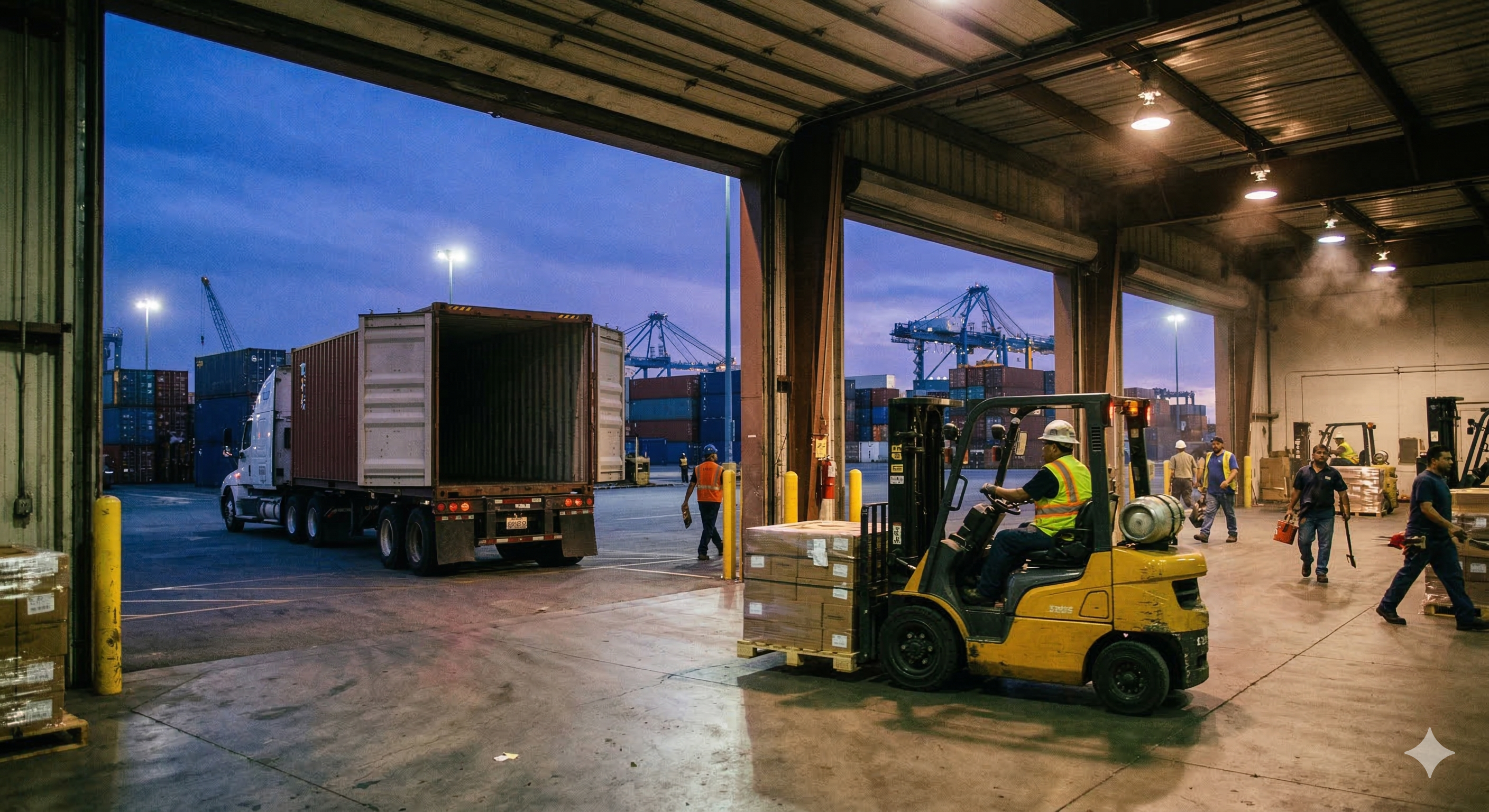
It happens in covered docks, dense yards, cross-docking zones, intermodal transfer points, underground spaces, warehouses, metal-heavy terminals, constrained facilities, mixed indoor-outdoor transitions, and routes where connectivity quality changes by the minute. These are not edge cases. These are core operating environments.
This is where conventional visibility models start to show their limits.
Some depend too heavily on external infrastructure. Others depend too heavily on favorable signal conditions. Others can produce events, but not a durable movement narrative. The result is a system that looks modern at the dashboard layer while remaining brittle at the operational layer.
That brittleness is now the real constraint on performance.
Because once the location layer degrades, every downstream promise weakens with it.
Labor coordination weakens because teams stop trusting the system.
Customer communication weakens because ETAs become less defensible.
Asset recovery weakens because operators lose search precision.
Routing confidence weakens because decisions are built on incomplete truth.
Exception handling weakens because ambiguity multiplies faster than teams can resolve it.
This is why the next chapter in transportation and logistics will not be defined by who adds the most intelligence on top.
It will be defined by who removes the most uncertainty underneath.
Why 2026 will reward continuity over connectivity
The old model of logistics visibility was designed around checkpoints.
You scanned at departure. You scanned at arrival. You tracked major transitions. You inferred the rest.
That model was acceptable when operations moved slower, customer expectations were looser, and the cost of ambiguity was lower. Those conditions are gone. The modern network is too compressed, too dynamic, and too margin-sensitive to tolerate large blind spaces between known events. Operators need more than episodic location. They need continuity. Continuity changes how the system behaves. It reduces the distance between event detection and intervention. It narrows the window between deviation and correction. It makes movement proof usable for operations, not just postmortems. It allows teams to manage flow instead of reconstructing it after the fact.
And most importantly, it creates a more stable operating narrative across environments that used to force a reset.
That is the real step-change ahead.
Not simply more connected workflows.
Not simply more automation.
Not simply more data.
More trustworthy position continuity across the places where logistics actually happens.
The problem with infrastructure-heavy tracking models
One reason this shift matters now is that infrastructure-heavy visibility models do not scale cleanly with operational ambition.
On paper, the legacy promise sounds manageable: add hardware, install the site layer, calibrate the environment, integrate the data, then extract value. The problem is not that this never works. The problem is what it asks the operator to become in order to make it work repeatedly.
Every new facility becomes a project. Every operating zone becomes a deployment scope. Every environment change becomes a maintenance issue. Every scale move carries not just software cost, but site complexity.
This is a structural problem, not a tactical one.
When positioning depends on installed infrastructure, rollout speed slows, deployment burden compounds, and operational adaptability shrinks. Visibility becomes something you build place by place instead of something you can extend as the business moves. That model increasingly clashes with the environments logistics teams actually manage. Networks expand. Layouts shift. Temporary operations appear. Conditions deteriorate. Priorities change. Customers demand precision faster than site instrumentation can keep up. The result is an organization that may have invested heavily in visibility while still living with blind spots in the highest-pressure parts of the network.
That is not the future state the market actually wants. The future state is lighter, faster, and more portable.
What the next wave of positioning looks like
The next wave in transportation and logistics will belong to operators that treat positioning as foundational operational infrastructure, not as a byproduct of hardware deployment. That means a different set of priorities.
It means infrastructure-free deployment instead of long installation cycles. It means polygonization that reflects the operational shape of a site instead of reducing location truth to rough map assumptions. It means synthetic IMU generation that expands where continuity can be sustained without depending on a dense external footprint. It means accuracy engines that focus on durable movement truth, not just event density. It means drift minimization because position confidence is only useful if it remains trustworthy over time and across transitions. It means on-device inference so operational awareness does not collapse the moment connectivity becomes constrained.
This is not a cosmetic improvement to visibility. It is a different operating model.
One where teams can stand up location continuity faster.
One where sites do not need to be turned into infrastructure programs before they become observable.
One where movement truth survives harder conditions.
One where operations do not have to choose between scale and certainty.
Why evidence quality matters more than data volume
Transportation and logistics does not suffer from a lack of data points. It suffers from too many weak ones.
The strategic winners in 2026 will not simply be the organizations collecting more operational data. They will be the ones building more defensible operational evidence. That distinction matters. Data abundance can still leave teams arguing about what happened. Evidence quality narrows ambiguity. Data abundance can still require manual reconciliation.
Evidence quality supports faster action.
Data abundance can still look impressive in reports.
Evidence quality changes how the network is run.
This is why continuous positioning matters so much. It turns location from a periodic signal into an evidence layer. It gives planners, operators, dispatchers, and field teams a more stable account of where movement actually occurred, where friction emerged, and where intervention is needed.
In a market obsessed with optimization, evidence is the hidden multiplier.
Without it, every workflow improvement remains fragile.
With it, intelligent operations becomes something more than a slogan.
It becomes executable.
How leading operators will rethink logistics visibility
The best transportation and logistics organizations in 2026 will not just be more digitized. They will be more position-aware. They will stop treating location as a feature attached to a workflow stack and start treating it as the truth layer beneath the stack. They will recognize that many of the industry’s persistent costs are really continuity costs in disguise.
Search time is a continuity cost. Exception volume is a continuity cost. Proof disputes are a continuity cost. ETA erosion is a continuity cost. Underutilized labor is often a continuity cost. Customer distrust is frequently a continuity cost.
And continuity is not solved by adding more interfaces over fragmented location assumptions.
It is solved by making positioning more resilient, more portable, and more operationally native.
That is the real transition now underway.
The next era of transportation and logistics will not be defined by who talks most convincingly about intelligent operations.
It will be defined by who can preserve trustworthy position continuity when operations leave the easy parts of the map.