
The Final 50 Feet Is Where Delivery Trust Is Won or Lost
If your delivery operation can confirm completion but still struggles to preserve trust at handoff, it may be time to rethink the positioning and evidence layer underneath the final 50 feet.
Juxta
Juxta Team
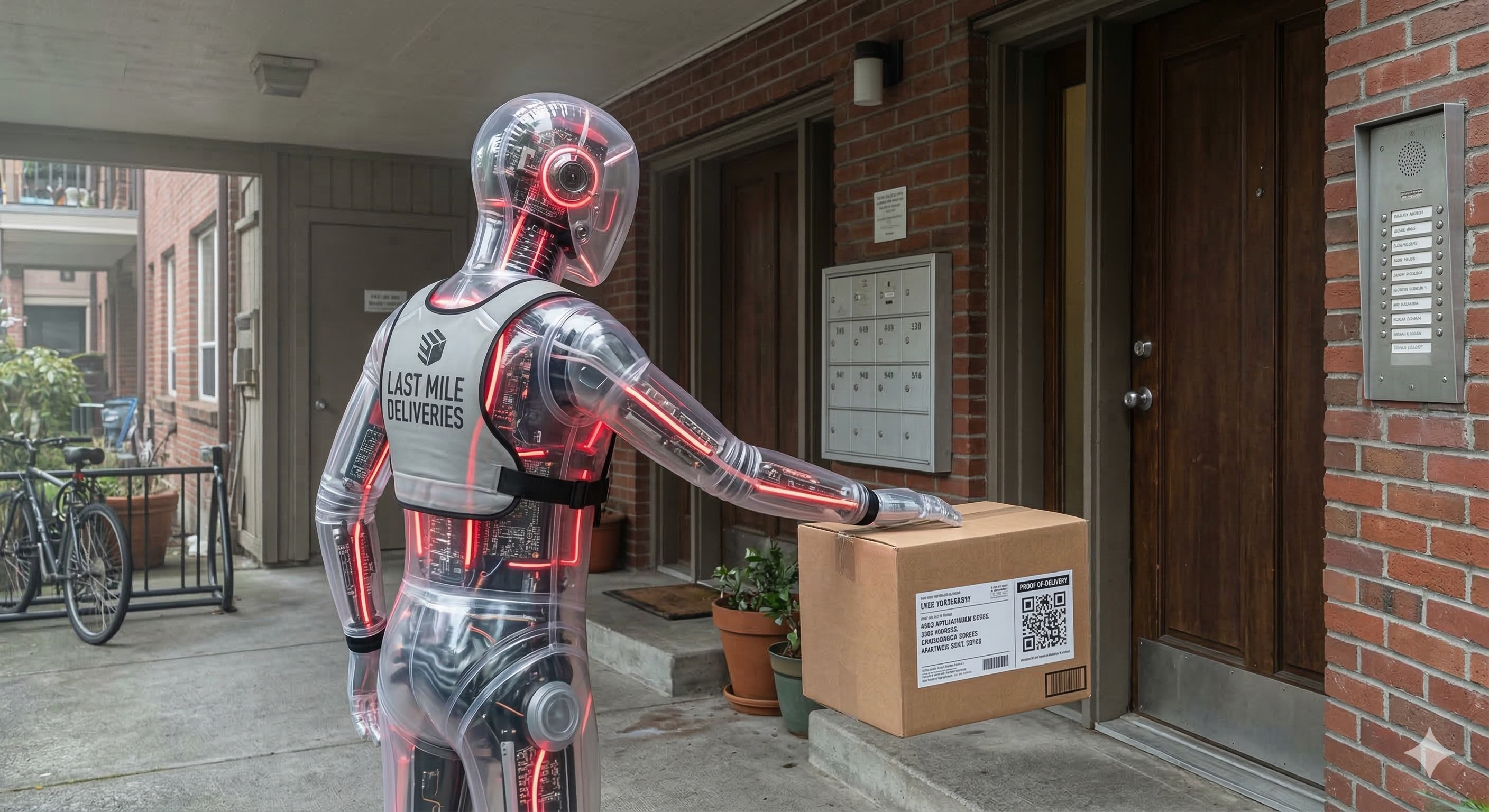
The last mile gets most of the attention. But the final 50 feet is where trust actually breaks. That is the moment when a package reaches the customer’s door, a handoff is supposed to be complete, and the operational system is expected to become proof. For the customer, it is the moment that matters most. For the operator, it is the moment where uncertainty becomes expensive.
Was it delivered to the right place?
Was it left in a visible or vulnerable location?
Did the handoff actually happen the way the system says it did?
Can the operation prove it without creating more friction for drivers, support teams, and customers?
Those are not minor questions. They sit at the intersection of customer experience, proof, accountability, and cost.
And they expose a larger issue in logistics: delivery systems are better at recording completion than preserving trust.
Delivery does not end at status confirmation
For years, logistics systems have been designed to optimize movement across the broader network. Route planning, dispatch, scanning, labor coordination, and shipment visibility have all improved. But the closer the operation gets to the customer, the more costly ambiguity becomes.
A status update that says “delivered” may complete the workflow, but it does not always complete confidence.
That gap matters because the customer does not experience delivery as a system event. They experience it as a moment of certainty or doubt.
If the package is not immediately visible, trust drops. If the delivery location looks wrong, trust drops. If the proof is incomplete, trust drops. If the support team cannot quickly resolve what happened, trust drops again.
The industry often treats this as a communications issue. It is actually an evidence issue.
The final 50 feet is where logistics stops being a routing problem and becomes a proof problem.
The real challenge is not speed alone
Faster delivery has become a baseline expectation. But speed without confidence creates a new kind of failure.
A package that arrives quickly but leaves the customer uncertain still generates operational drag. It creates inbound support volume. It triggers disputes. It forces manual investigation. It weakens perceived service quality. It shifts the burden of resolution from the network to the customer-facing team.
This is why the final 50 feet matters so much.
It is one of the smallest physical segments in the delivery journey, yet one of the most important operationally. It is where the system has to convert movement into evidence. And many delivery models still struggle with that transition.
The problem is not simply whether the package reached the destination. The problem is whether the operation can establish trustworthy completion without introducing more labor, more exception handling, or more customer anxiety.
That is a much harder standard.
Why proof has become a core logistics function
Proof used to be a back-office concern. Now it is part of the product experience.
Customers want immediate confidence. Operators want fewer disputes. Delivery teams want less follow-up work. Support organizations want fewer avoidable tickets. Everyone wants the same thing: a delivery outcome that can be trusted without requiring extra effort.
That makes proof operational, not administrative. And operational proof has to meet a much higher bar than simple confirmation. It has to be fast enough to preserve flow, clear enough to reduce ambiguity, and lightweight enough that it does not slow down the person doing the work. This is where many systems create the wrong tradeoff.
They either increase the burden on the frontline to create better proof, or they accept weaker proof in order to preserve speed. Neither approach solves the real problem. One increases labor friction. The other increases downstream cost.
The better model is different - it preserves proof without turning the proof process into another workflow burden.
The final 50 feet exposes a larger visibility problem
There is a tendency to treat doorstep proof as a narrow delivery-use case. It is not.
It is a compressed version of the same visibility challenge that exists across logistics more broadly: the system can often observe parts of the journey, but struggles to preserve trustworthy context at the moment of handoff.
That same pattern shows up everywhere. At a yard gate, the system sees entry but loses continuity inside the covered area. At a warehouse transition, the system registers the checkpoint but not the exact movement path. At a final delivery handoff, the system knows the route was completed but cannot always preserve the right level of proof around completion quality. These are all versions of the same operating problem. The movement happened. The workflow advanced. But the trust layer remained weaker than it needed to be.
The final 50 feet simply makes that weakness more visible because the customer sees the consequences directly.
Why burdening the frontline is the wrong fix
One common response to trust gaps is to push more verification work onto the frontline.
Take more steps. Capture more details. Follow more confirmation rules. Do more to prove the handoff.
That may improve records in some cases, but it also increases the cost of every delivery. It slows the worker down, complicates execution, and creates more room for inconsistency.
The frontline should not be forced to choose between speed and proof.
That is the wrong system design.
When operators rely too heavily on manual proof creation, they make service quality dependent on extra human effort at the exact moment the workflow should remain simple and fast.
That model does not scale well.
High-volume delivery environments need proof mechanisms that support the worker instead of adding friction to the worker. They need systems that can strengthen trust without turning every handoff into a heavier process.
That is where better positioning and better operational evidence start to matter.
Why trust depends on stronger evidence, not more messaging
When delivery trust breaks, organizations often respond by improving notifications, support scripts, and customer communications. Those things help.
But messaging cannot compensate for weak evidence forever. If the customer is uncertain, the operation needs a way to resolve that uncertainty quickly. If a package is disputed, the system needs defensible proof. If support volume spikes, teams need a clearer source of truth than status language alone. That means the real lever is not better explanation after the fact. It is better operational evidence in the moment of completion. And evidence only becomes useful when it is generated in a way that does not disrupt execution. This is one reason the final 50 feet deserves more strategic attention. It sits at the point where proof quality, customer trust, frontline efficiency, and cost-to-serve all converge.
A stronger final handoff does more than reduce complaints.
It improves the economics of delivery.
What better final-delivery operations actually require
To improve the final 50 feet, operators need more than another customer-facing feature. They need a stronger operational model beneath the handoff itself. That means rethinking how completion is established.
It means treating proof as a native part of execution rather than a bolt-on confirmation step. It means reducing dependence on manual processes that add friction at the doorstep. It means building for continuity so the handoff is not isolated from the broader movement narrative. It means using infrastructure-free deployment so trust improvements do not depend on site-specific installs or dense physical overhead. It means relying on accuracy engines that strengthen movement truth rather than simply creating more event noise. It means drift minimization so completion context remains dependable, even in the harder environments where delivery operations often lose confidence. It means on-device inference so key operational decisions & validations can remain available without perfect connectivity.
This is the larger shift.
The future of delivery trust will not come from more status updates.
It will come from better evidence generated closer to the moment of execution.
The strategic lesson goes beyond the doorstep
The final 50 feet matters because it teaches a broader logistics lesson. Customers do not judge an operation by how much data it collects. They judge it by whether the operation can create confidence at the moment confidence is needed. That is the standard more delivery networks now have to meet.
And it is why the next wave of logistics improvement will not be defined only by faster routes or denser networks. It will also be defined by whether operators can close the trust gap at handoff without increasing labor burden or operational complexity. The strongest delivery organizations will recognize that trust is not a soft metric.
It is an operating outcome. It reduces support costs. It reduces disputes. It protects brand confidence. It improves proof. It strengthens the final handoff without slowing the network down. That is what makes the final 50 feet so important.
It is not the last step in delivery.
It is the step that proves the system worked.