
The Capital Intensity of Telematics Scaling
Telematics transformed fleet visibility. By combining GPS hardware, cellular connectivity, and cloud dashboards, fleet operators gained real-time insight into vehicle location, safety behavior, fuel usage, and compliance. But as fleets scale, a structural issue emerges: Telematics does not just scale operationally. It scales financially. And not in a linear way that favors agility.
Juxta
Juxta Team
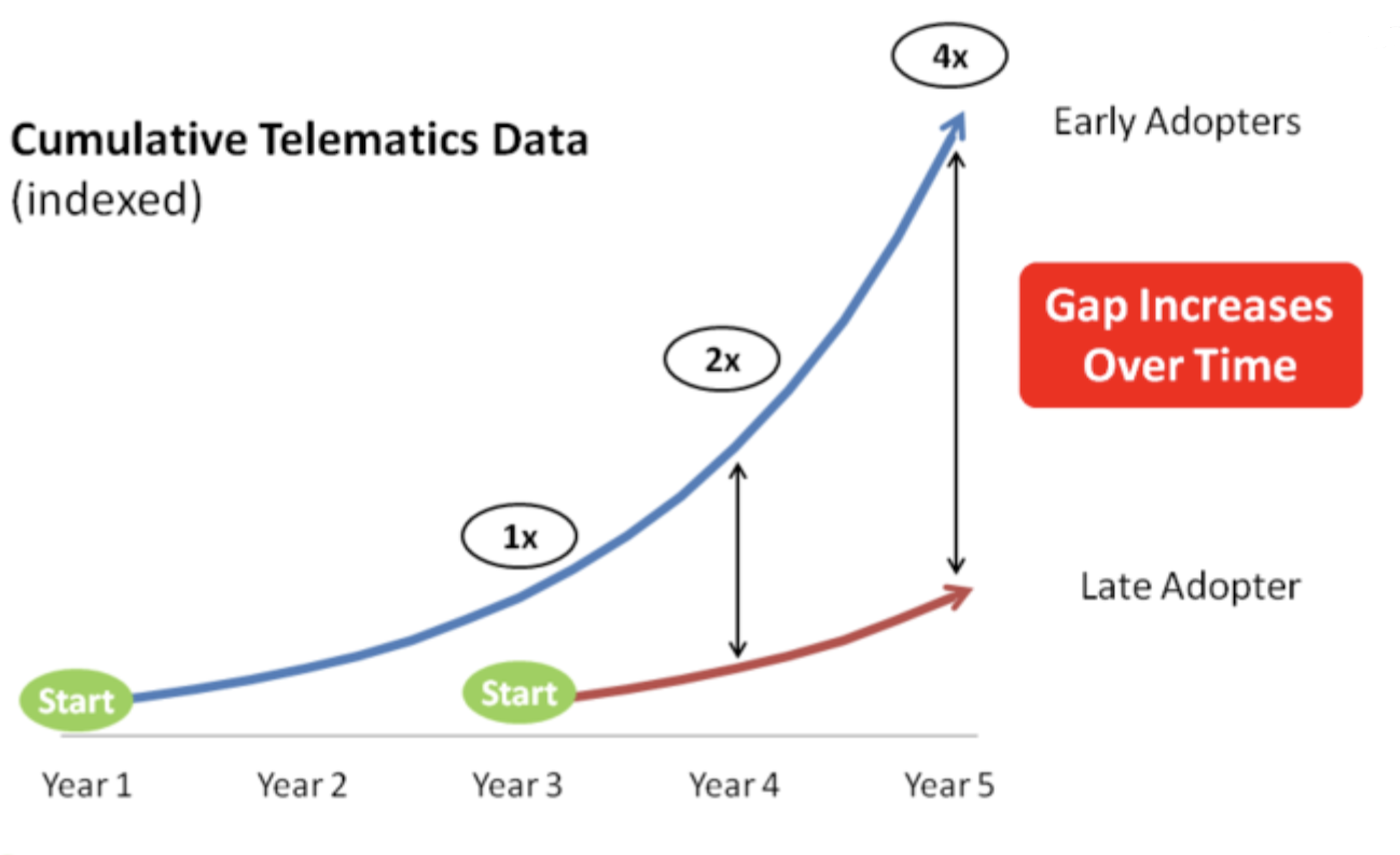
The Hardware Multiplier Effect
Traditional telematics is hardware-first.
Every additional tracked asset requires:
- A physical device
- Installation labor
- Connectivity provisioning
- Lifecycle management
At small fleet sizes, this feels manageable.
At enterprise scale, it becomes a multiplier.
Tracking 100 vehicles is procurement.
Tracking 10,000 vehicles is capital planning.
Hardware-driven systems tie growth directly to device count.
Every expansion — new depot, new region, new division — triggers a fresh infrastructure cycle.
Upfront Capital Before Operational Value
The financial burden of telematics scaling does not begin with monthly subscriptions.
It begins with deployment.
Before a fleet sees full visibility, it must:
- Purchase hardware in bulk
- Schedule installation across distributed sites
- Absorb vehicle downtime
- Coordinate logistics across regions
- Ensure connectivity coverage
Only after installation is complete does the system deliver comprehensive value.
Scaling becomes gated by capital allocation and rollout speed.
The larger the fleet, the longer the lag between investment and return.
Distributed Infrastructure Equals Distributed Risk
Hardware scaling introduces more than expense.
It introduces distributed operational exposure.
As device count grows, so does:
- Failure surface area
- Firmware update complexity
- Connectivity troubleshooting volume
- Warranty replacement cycles
- SIM and carrier management overhead
Device fleets become a parallel infrastructure layer requiring continuous oversight.
At scale, telematics is no longer just a software subscription.
It is a hardware estate.
The Connectivity Dependency Curve
Telematics scaling is not just hardware scaling.
It is bandwidth scaling.
More vehicles mean:
- More cellular contracts
- More data plans
- More roaming agreements
- More dead-zone exceptions
- More GPS signal degradation scenarios
Outdoor fleets appear straightforward — until they enter:
- Covered loading facilities
- Dense industrial complexes
- Multi-level depots
- Urban signal corridors
- Remote or RF-constrained regions
Capital investment does not solve signal physics.
GPS and cellular remain structurally constrained technologies.
Scaling within those constraints compounds cost without eliminating blind spots.
Capital Lock-In and Refresh Cycles
Hardware-based telematics systems create capital lock-in.
Devices have lifecycle limits.
Technology evolves.
New capabilities require new hardware generations.
Fleet operators must periodically:
- Replace aging devices
- Migrate installations
- Re-certify compliance
- Reconfigure integrations
Scaling telematics is not a one-time capital event.
It is a recurring capital obligation.
Security Costs Compound at Scale
Every RF-dependent device introduces:
- Signal emission
- Cloud routing
- Potential spoofing vectors
- Jamming vulnerability
At small scale, this is manageable.
At national or defense-grade scale, it becomes strategic exposure.
Security hardening adds additional cost layers:
- Encrypted communications
- Network redundancy
- Device-level protections
- Monitoring infrastructure
The capital intensity of telematics scaling includes security mitigation — not just tracking capability.
The Scaling Paradox
Here is the paradox:
The larger the fleet becomes, the more telematics is needed.
But the larger the fleet becomes, the more telematics infrastructure constrains agility.
Expansion into a new facility should require operational planning.
Instead, it often requires:
Procurement
Installation
Connectivity provisioning
Testing
Maintenance planning
Scaling becomes slower as the organization grows.
Capital compounds.
Operational friction compounds.
Infrastructure gravity compounds.
The Architectural Alternative: Software-Defined Positioning
A fundamentally different model is emerging.
Instead of scaling with hardware count, it scales with model deployment.
This approach:
- Converts environments into polygonized spatial models
- Generates synthetic IMU data to eliminate physical site walkthroughs
- Trains transformer-based accuracy engines
- Executes positioning on-device
- Operates without GPS, cellular, WiFi, BLE, or anchor infrastructure
Scaling becomes computational — not physical.
Adding 10,000 assets does not require 10,000 installations.
Expanding into new facilities does not require hardware procurement cycles.
Capital shifts from distributed device management to centralized model training.
Why Capital-Light Architectures Win at Scale
When positioning is infrastructure-free:
Deployment compresses from months to hours.
Expansion does not require field technicians.
Offline operation is native.
RF vulnerabilities are eliminated.
Lifecycle refresh cycles disappear.
Scaling becomes software iteration.
Not hardware multiplication.
And in capital markets, capital-light architectures consistently outperform capital-heavy ones over long horizons.
The Inflection Point
Telematics solved first-generation fleet visibility.
But as fleets become:
- Larger
- More distributed
- More security-sensitive
- More automation-driven
- More indoor-outdoor hybrid
The capital intensity of hardware scaling becomes strategically limiting.
The future of fleet intelligence is not more devices.
It is fewer dependencies.
Fleets that transition from hardware-defined tracking to software-defined universal positioning will unlock:
- Faster geographic expansion
- Lower capital exposure
- Higher resilience in signal-denied environments
- Structural cost advantage over time
The telematics era digitized fleets.
Our era removes infrastructure from the equation.