
Hospitals Do Not Need More Workflow Tools. They Need Location Certainty.
If your hospital is still relying on fragmented visibility, manual search, and infrastructure-heavy tracking to coordinate care, it may be time to rethink the location layer underneath operations.
Juxta
Juxta Team
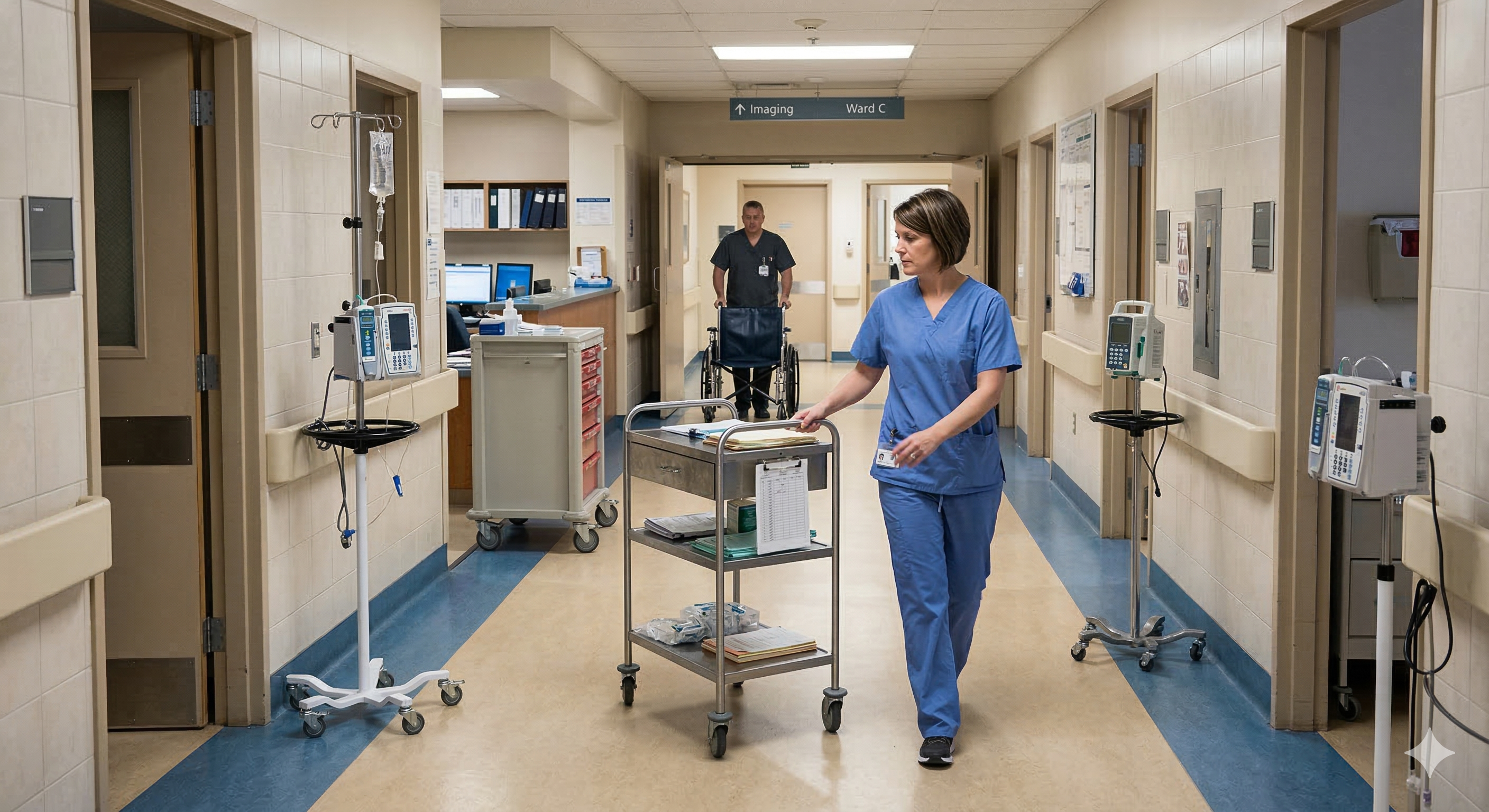
Healthcare is not short on software. It is short on certainty.
Hospitals have spent years layering on communication platforms, mobile devices, workflow systems, alerts, and digital coordination tools in an effort to reduce clinician burden and improve care delivery. Those investments matter. But in many facilities, the daily operating reality still feels fragmented.
Nurses still search for equipment.
Teams still lose time chasing updates.
Staff still work around uncertainty instead of through clear operational truth.
Patients still experience delays that begin long before anyone notices them in a dashboard.
The problem is often described as a workflow challenge. In practice, it is just as often a location challenge. Because when hospitals cannot maintain trustworthy awareness of where people & assets in real time, every downstream workflow becomes slower, noisier, and more labor-intensive. That is the hidden constraint inside modern care delivery.
Clinical burden is often a search problem in disguise
A great deal of clinician frustration is not caused by care itself.
It is caused by everything wrapped around care: searching for infusion pumps, locating wheelchairs, finding mobile diagnostic tools, confirming whether equipment is available, in use, delayed, misplaced, or sitting in another unit. Tracking the movement of critical assets between rooms, departments, and floors. Trying to coordinate care inside an environment where operational context is always slightly incomplete.
These moments may look small in isolation, but they accumulate fast. Every search event interrupts focus. Every delay creates downstream pressure. Every unclear handoff increases the burden on already strained staff.
This is why hospital operations cannot be improved by messaging layers alone. Communication matters, but communication is not the same as certainty. Telling a team where something might be is not the same as knowing where it is. Routing a request faster is not the same as removing the uncertainty that caused the request.
When operational truth is weak, people compensate manually. That compensation becomes part of the care environment. Over time, it feels normal. But normal does not mean efficient.
Connected care breaks when location truth is fragmented
Hospitals increasingly want a more coordinated operating model. That makes sense. Care is inherently cross-functional. Nurses, transport teams, pharmacy, environmental services, technicians, and administrative staff all depend on shared timing and shared context. But shared context only works when the underlying signals are trustworthy.
If a hospital can digitize requests but not preserve awareness of where equipment has gone, coordination still breaks. If alerts move faster than assets do, the system produces more noise, not more control. If staff can communicate instantly but still have to search manually, the burden has not been solved. It has only been rerouted.
This is where many care environments get stuck.
They improve the communication layer without improving the operational truth layer beneath it. The result is a hospital that appears more connected on paper, while still depending on workarounds in practice. That is not a sustainable model for care delivery. Especially not when staffing pressure is high, patient throughput matters, and every minute of recovered clinician time has compounding value.
Why hospitals cannot keep solving this with more infrastructure
Historically, hospitals trying to improve asset visibility have had to accept a difficult tradeoff.
If they want more precision, they often need more hardware: more tags, more readers, more anchors, more gateways, more site planning, more installation, more maintenance, more reconfiguration when layouts or priorities shift. The model can produce results, but it also turns operational visibility into a facilities project. Every improvement has a physical footprint. Every expansion carries deployment overhead. Every change increases the long-term maintenance burden.
That is a poor fit for healthcare environments.
Hospitals are dynamic, not static. Equipment moves unpredictably. Units get repurposed. Temporary workflows become permanent ones. Capacity constraints force operational improvisation. The environment changes faster than infrastructure projects can adapt. And in care settings, deployment friction matters more than it might in a simpler industrial site. Every added system competes for attention, budget, and tolerance inside an already complex environment. This is why hospitals need a lighter model - it is too important to remain dependent on assumptions.
Better hospital operations start with infrastructure-free awareness
The next step forward in healthcare operations is not another layer of disconnected workflow tooling. It is a more reliable awareness layer underneath the workflows. That means infrastructure-free deployment, so hospitals can improve visibility without turning every facility into a hardware program. It means polygonization that reflects real care zones, unit boundaries, treatment areas, and operational handoff points. It means synthetic IMU generation that supports continuity without assuming dense physical instrumentation. It means accuracy engines that prioritize dependable movement truth rather than intermittent event confirmation. It means drift minimization, because room-level or zone-level confidence only matters if it remains stable as assets and people move through the facility. It means on-device inference, so operational awareness can remain available even when network quality is imperfect or facility conditions are inconsistent. This is not a technical luxury. It is an operational necessity.
Hospitals do not need more point solutions that generate more alerts while leaving staff to resolve the same uncertainty manually. They need a more dependable foundation for where things are, where they moved, and whether they are available when needed.
The real outcome is not asset tracking. It is clinician time recovery.
The most important metric in healthcare operations is not the number of devices connected to a workflow platform.
It is whether the system gives time back to the people delivering care.
When staff spend less time searching, they spend more time treating. When equipment is easier to find, delays shrink. When handoffs are clearer, escalation volume falls. When availability is more trustworthy, work gets routed with less friction. When movement truth improves, the hospital becomes easier to run. This is why the asset visibility conversation is too often framed too narrowly. The goal is not simply to track things. The goal is to reduce the hidden tax that uncertainty places on care delivery.
That tax shows up as delay. As frustration, as duplicated effort, as underused equipment, as slower room turnover, as clinician interruption, as operational drag that no one set out to design, but everyone ends up carrying.
Recovering that lost time is one of the highest-leverage moves a hospital can make.
The hospitals that lead will treat certainty as infrastructure
The strongest healthcare operators will not think about visibility as a dashboard feature.
They will think about certainty as operational infrastructure. They will recognize that many care-delivery slowdowns begin before the clinical decision itself. They begin when the system cannot provide dependable awareness of where equipment, people, and activity are in the moment they matter. They will stop accepting search as a normal part of care. They will stop treating delay as a pure staffing issue. They will stop assuming that more communication automatically solves coordination. Instead, they will focus on building a care environment where operational truth is easier to access, faster to trust, and lighter to deploy. That is how clinician burden actually comes down. Not through more software alone. Through better certainty underneath the software. And in hospitals, certainty is not a convenience.
It is a force multiplier for care.